Showing posts with label Arthur William Matthews. Show all posts

Thursday, June 16, 2016

Treasure Chest Thursday - Arthur Matthews' Bible

Over two weekends last September, Donald and I went through my step-mother's basement, finding many hidden treasures from my Dad's family in the way of Bibles, books, furniture, documents, photos, negatives, china and silver. After months of airing-out I am trying to devote at least an hour every week to scanning and photographing these items and sharing them with you on Treasure Chest Thursday.

On the second weekend of our cleaning out of my step-mother's basement last September, we were working our way through Dad's books. This was not an inconsiderable task. My father was a voracious reader and seldom parted ways with a book he had purchased. We were close to calling it a day, my step-mother was somewhat annoyed that we weren't taking more (Dad had an office and a library in their basement, I have a two-bedroom apartment) when suddenly she spied two piles of books on their backs behind the books on one of the shelves. As happened frequently during those two weekends, this discovery was quickly followed by a sharp intake of breath and lots of "Oh my goodness!" and other exclamations. What she had uncovered was a literal stack of Bibles and prayer books, one older than the next and all incredibly precious.


This Bible belonged to my paternal great-grandfather, Arthur William Matthews, his name barely still legible on the cover. It was likely not his first Bible, as it was published in 1901.


The first name inside is not Arthur's but that of his granddaughter, Louise Ahlers, but she was only four when he died in 1915, so perhaps it was given to eldest daughter Bess Matthews, Louise's mother, upon his death.  Later, it appears to have been passed to my grandfather while he was at Wyoming Seminary which was 1922-1924. My father signed it when he was nine, I don't know if it had been given to him then. How I wish Dad had shared these things with me when he was alive.


As I get back to my Research Plan with a capital R and capital P, I look forward to learning more about my great-grandfather's life in Coleford, Somerset, England. I believe the church played an important role in his life there, perhaps providing his academic and musical education. Information I have gleaned from his probable baptismal record leads me to believe that the family was very poor when he was born, and yet he composed music, lead the choir at the Methodist Episcopal church in Pittston, PA and played at least one instrument, the violin. Come to think of it, I wonder, with the embossing on the cover, if this Bible was a gift from the church or the members of the choir?

When I was trying to decide which parts of this Bible I should photograph, I decided that I would start with a couple of passages, Luke 2:36 and 1 Thessalonians 5:18. Family mythology says that I am named for Anna the prophetess of the Gospel According to St. Luke, so I went in search of that passage only to find a couple of pages missing. 1 Thessalonians was in-tact, though.


I Thessalonians 5:18 "In everything give thanks: for this is the will of God
in Christ Jesus concerning you."

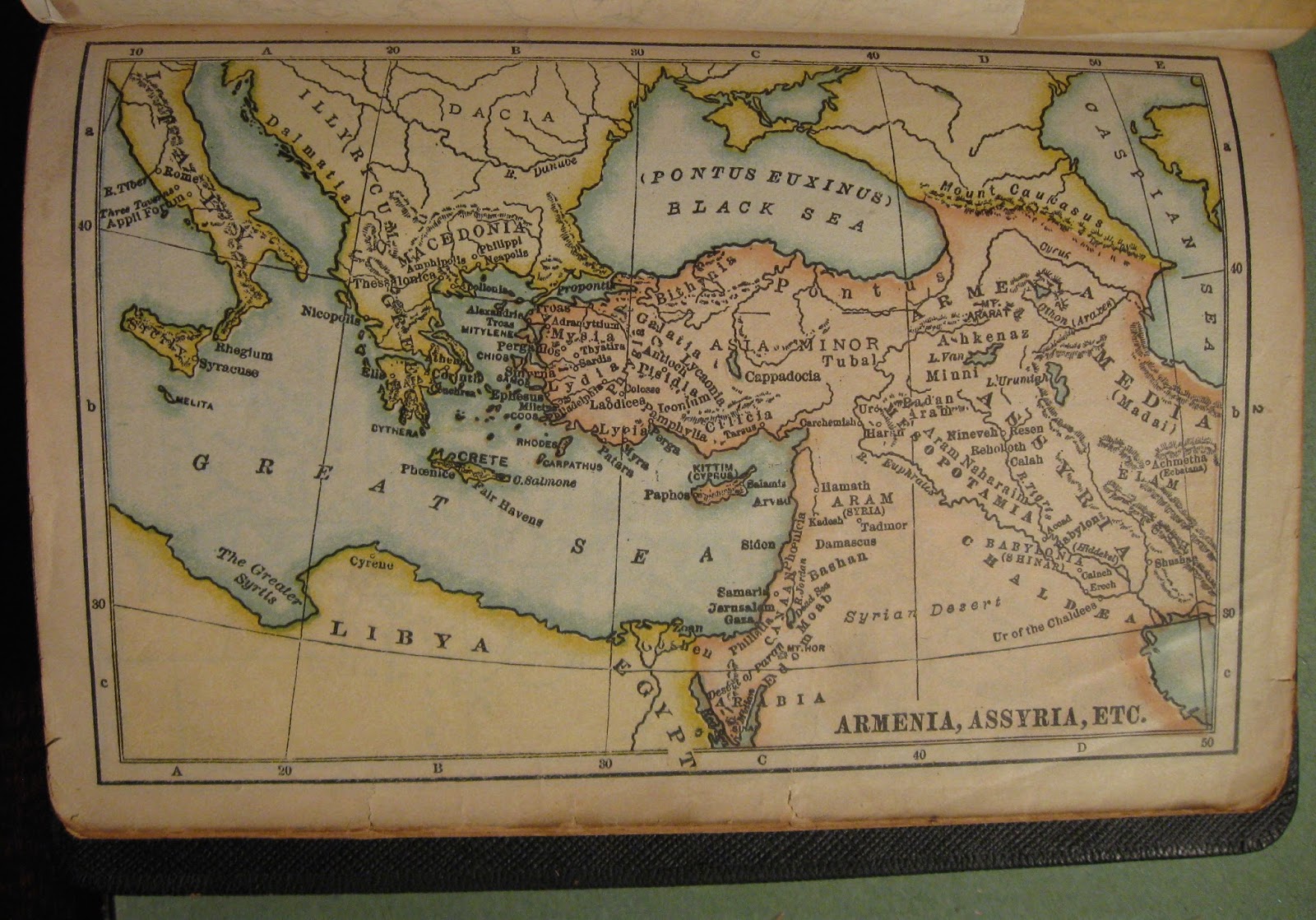
This Bible also includes "Readers' Aids"; "Brief treatises upon and outlines of topics related to the study and understanding of the Holy Scriptures" and also a concordance and word guide including index, gazetteer and these maps.


I'm happy to have this much of the Bible photographed now, so that I can take a closer look at some of these maps without risking damage to the Book itself.

Next weeks Bible is much older, it belonged to Arthur's wife, my Great-Grandmother Ada Merritt Hobbs and she dated the inside of the cover 1867.

Sunday, December 6, 2015

Arthur William Matthews - d. December 6, 1915 - Turned None Away

My great-grandfather, Arthur William Matthews, died 100 years ago today.  Until recently all I had or knew of him was one photograph and some of my grandfather's written memories. And that is a lot, more than a lot of people have, but I was very happy to find more about him when I subscribed to Newspapers.com last year and again this past September in Dad's secret stash.
Arthur William Matthews
b. 1844 Coleford, Somersetshire, England
d. Dec. 6, 1915, Pittston, PA

From the Pittston Gazette, Wed Dec 8, 1915
If you have read any of my grandfather's autobiography which I transcribed over many weeks for Amanuensis Monday, you might remember that Arthur came to the United States as a member of an orchestra in 1865. Once settled in Pittston, he led the choir at the Methodist Episcopal Church for many years and owned a music store. He also composed music, including for this hymn, "I Left it All with Jesus, Long Ago."


I was over the moon to find this in September, I had read that my grandfather had it, but had never seen it.

Also, among a literal stack of Bibles and prayer books, I found this.


The embossing is almost completely gone on the cover. It reads A W Matthews.

It's nice to have these physical connections to my great-grandfather, but even more than this, and especially in this Advent Season, I remember most proudly one thing that my grandfather wrote in his autobiography, "The visitor was there by virtue of my father's rule that no one ever be turned away from the Matthews house hungry." Amen.

Monday, February 9, 2015

Amanuensis Monday - Life in the Mines


This is the 10th installment of my grandfather, Howard B Matthews', story.  In the last installment, his father, Arthur William Matthews, passed away at the age of 71, when my grandfather was only 14.  The following year, after the family moved out of Pittston, it was decided that my grandfather should leave school and contribute to the income of the family so that his brother Charles could be married.


After his father's death, my grandfather's family had to sell everything and move out of Pittston. 

The mechanic to whom I was assigned was named Jerry, an Englishman.  His shop, equipped with benches and tools, was located in a whitewashed and well lighted area near the foot of the shaft.  It was his job to maintain and sometimes replace the steam operated pumps which controlled the level of constantly dripping water in the mine, and various other machinery throughout the mine.  He took me on his rounds of many areas and levels of the mine, packing valves, tightening pipe joints, replacing clutch facings, etc., warning me to watch out for bare overhead wires, teaching me not to panic if my light blew out.  When later he trusted me to make a miles long trip alone, getting there, making a minor repair, getting back, -- a walk of several miles without meeting a soul, it was for me a major victory.  But Jerry could be tough; he chewed tobacco, began and ended every sentence with a curse and vowed that he would kill me if I ever missed the cutting tool that he was holding and I was supposed to hit with a sledge hammer. I never missed.  It took me years to get over thinking sentences without cuss words in them.

Soon it became apparent that what the Super really hired me for was to be the keeper of the Yardage Books.  In these were kept a record of the length and thickness of the rock a miner had to blast down and load in order to get the number of loaded cars he and his helpers produced and he was paid additionally for the aforesaid hindering rock.  He was an independent contractor and could hire as many helpers as he wished.  The payment for rock made up for any slowing down in his coal production.

In every two-week pay period I had to accompany the Assistant Superintendent, Malachi Glennon, on a tour of the entire mine, right up to the “face” of each of the scores of chambers (tunnels) where the actual  mining, the blasting and loading of coal was going on.  As we came to each area we were met by its foreman who accompanied us over his “workings”.  His primary responsibility was to push for loaded cars to meet the daily goals set by the Super but he of course knew of the problems encountered by his miners and he guided us in the allowances I entered in the yardage book.

These journeys were very interesting and I was either too young or too dumb to recognize the dangers although they did expose me to many of the dangers associated with underground mining.  Certainly, as I recognized later, I was safer just being with Malachi Glennon, a wonderful man then in his 50’s, huge but not fat, red-faced, redolent of last night’s liquor, but a kindly family man, father of a young man who was a stationary engineer at the head of one of the slopes I have described.

Malachi and I together were involved in two of the kind accidents typical of mining,  - a gas explosion and a fall-of-rock, otherwise known as a roof cave in.

Mines are ventilated by a forced air system which brings fresh air from outside, through the long tunnels and then by a series of doors and temporary movable ducts, called brattice-work, right up to where the miners are working at the face of the chambers.  The force of a sudden release of a pocket of gas, ignited either by blasting powder or any source of sparks or flame, reverses the flow of air, blasts open the control doors and scatters particles of coal and rocks. It was the air reversal and flying specks hitting us in the face that told Malachi what was happening. He immediately threw me to the ground and covered me with his own body.  We lay there while the burning gas, rolling along about 2 feet below the ceiling, burned itself out without harm to us.  Had there been enough gas to fill the entire tunnel we would have been burned to a crisp.

Again in the roof cave-in, because of his many years of experience, Malachi understood the implications of the sounds he heard, - the cracking of roof rock and the groaning of support timbers.  He pushed me ahead and we ran as tons of rock and timbers crashed behind.

It was some time after these events that Malachi asked me what I intended to do with my life and what were my ambitions.  I replied that I would like a job like his.  Malachi stared at me a while and then said: “Howard, get the hell out of here before you get kilt”. Probably after saving me twice he didn’t want to stretch our luck. Because of his concern and the knowledge that my working underground was worrying my mother sick, I decided to give it up despite the fact that inside jobs paid much better than outside jobs.  Besides, it was hurting my social life for, scrub as I did every day, it was difficult to get that coal dust out of my pores.  When I perspired it oozed out of my pores.  I remember one Sunday when I walked Miss Celeste Bonti home after Epworth League and her mother met us at the door and said, “Howard Matthews, don’t let me catch you kissing my daughter”.  (Actually, I had a find social life, unhindered by my job.)  I have wondered since why the family permitted me, at age 16, to go into the mines in the first place.  Around Pittston it might have been considered a natural thing to do, but we were living in Forty Fort, a rather affluent suburb.

In the next installment, my grandfather sees what can come from a good education and is determined not only to go back to school, but a very good school.

Transcription of above article: Mrs. Arthur Matthews and family, including Mr. & Mrs. William Ahlers, who have lived for many years on Nafus Street, have moved to Forty Fort, which will be more convenient for Mr. Ahlers, who is Chief Clerk for the Lackawanna division of the Lehigh Valley Coal Co. at the Wilkesbarre [sic] office, and also for Chas. Matthews, who is employed as colliery clerk at the Maltby colliery, of the Lehigh Valley.  The Matthews property, on Nafus street, consisting of the homestead and a single dwelling on the rear of the lot, has been sold to the Gaughan family, of Port Griffith, who have already moved to their new home.


Sunday, October 5, 2014

Sunday's Obituary - Arthur W Matthews

Last Monday in my Amuensis Monday post we got to the part in my grandfather's story where his father, Arthur William Matthews, passed away.  Last year I was lucky enough to find his obituaries on Genealogy Bank.


A large concourse of sorrowing friends and relatives were in attendance yesterday afternoon at the funeral of Arthur Matthews, which was held from the family home on Nafus Street.  Services were conducted at the house by Rev. L.E. Van Hoesen, pastor of the M.E. Church.  The services consisted of a prayer, suitable address, the reading of Tennyson's "Crossing the Bar," and the singing of "Abide With Me," by a quartet composed of Fred Fear, Harvey Harris, Mrs. Lillian Daniels and Mrs. Charles B. Smith.  The floral tributes were many and completely covered the casket.  The pall bearers were four sons and two sons-in-law of the deceased.  They were William, John, Leroy and Fred Matthews, Floyd Hunter and William Ahlers.  Interment was in Pittston Cemetery.

I love the melodrama in that opening sentence and of the elements of  service.  I don't mean to make light of his death, though, it changed everything for my grandfather who was the youngest of his eight children and only 14 when Arthur died at 71.  If you're interested, you can read more about that in my Amanuensis Monday posts.


Saturday, October 4, 2014

Shopping Saturday - Pittston Shoe Factory & City Music Store

Since I first read my grandfather's autobiography and family history I have known that his father, Arthur William Matthews, owned a local music store in Pittston, PA and that he was a violinist, composer and choir director, but finding out that he owned a shoe factory was a more recent revelation.

I first found mention of it in this article from the Wilkes-Barre Times that said my great-grandmother had thrown a dinner for the employees of the family shoe factory.  The dinner was given in 1905.  I was intrigued, but could not find anything further.

BREVITIES. Thursday evening Mrs. Arthur Matthews, of Nafus street, tendered a banquet to the employees of the Pittston shoe factory, of which her husband is proprietor, and it was a most enjoyable affair. Miss Bessie Matthews entertained the company with several vocal and instrumental selections.


At the end of our short trip to Pennsylvania last year we found ourselves at the Northeast Pennsylvania Genealogical Society where they had one incomplete city directory from 1890 listing the members of the Matthews family with information about their businesses (below). While this confirmed that Arthur did indeed own a shoe factory I was disappointed to find that the referenced ads were missing.


Recently I was very excited to find these ads on Ancestry:


So many questions remain for me, though.  Why is Arthur's son William listed as the proprietor?  What made them open a shoe factory?  What is Dongola? And why did the music store and shoe factory close?  Why was the family in debt when Arthur died in 1915? And why wasn't any of this in my grandfather's family history?

Two of those questions were answered for me this week when I found another obituary for Arthur from the Pittston Gazette on newpapers.com.  Although seriously ill only for the last three weeks of his life, Arthur had apparently been in poor health for a few years and was forced to close the shoe store around that time.  There were no details in the article about the music store.

Last year someone shared a turn of the century photo of a Pittston business on the Facebook page of the Greater Pittston Historical Society.  I was green with envy! I'd give my left arm for photos of this family and their many ventures.

I will be on vacation the week of Columbus Day and after a short trip to visit family in Canada I will be spending a day helping my stepmother go through some of my father's things.  I doubt if I will find any photos of the Pittston Shoe Factory but whatever I do find I'll be sure to share here.


Tuesday, September 30, 2014

Tombstone Tuesday - Arthur W Matthews, Dec 6 1915, Age 71

Yesterday I posted the part of my grandfather's story in which he loses his father.  Later this week I will post my great-grandfather Arthur's obituary. Today, I am posting a photo of his headstone.

Just about a year ago we visited my grandfather's hometown of Pittston, PA and the cemetery where my great-grandparents and other relatives are buried.  I shared about that visit here and especially the help I received from the Greater Pittston Historical Society.  I only found the headstone in the very large Pittston Cemetery with their help.


Arthur W Matthews - December 6, 1915, Age 71

Monday, September 29, 2014

Amanuensis Monday - Everything Changes

This is the 9th installment of the autobiography and family history written by my paternal grandfather, Howard Beirly Matthews.  It is December of 1915, my grandfather is 14 years old and everything in his world is about to change.

Arthur William Matthews


Dorothy has said that Grandpa Matthews, my father, must have had a good position for the family lived well and he worked at the mines only the first two hours of the day and that he was a very generous man.  Perhaps he had been too generous; when he died there was very little left but life insurance, the family home and a bunch of debts remaining, perhaps, from his oft expressed boast that when Arthur Matthews needed money he just went to the Bank and got it.  I remember that when I needed a pair of new shoes my father always said go get them and charge them to Arthur Matthews.  My first long-trousered suit was a Hickey Freeman, which cost $15!!!

So a year or so later the house was sold and we moved to Forty Fort, Pa. near Wilkes-Barre to be near Will Ahlers' office and that of my brother Charles at the Maltby mine of the Lehigh Valley Coal Co.  I commuted to Pittston to complete my Sophomore year at its High School.

In those days very few from our area went to college, altho Floyd Hunter's sister graduated from Cornell, and not many even finished High School.  And since my brother Charles, then 21, wanted to plan on getting married, it was decided that I should not return to High School but get a steady job and contribute to the family income.

In the summer of 1917, with World War I creating a great demand for coal and so many jobs vacated by men joining the armed forces, I found it easy to get a job, underground, at the Maltby mine of the Lehigh Valley Coal Co., whose Supt'd. lived just a block away from us.  He hired me as a "mechanic's helper" and told me to be at the mine shaft at 6:30 am, properly clothed and equipped by which he meant overalls, a cap and an acetaline [sic] (gas) lamp, a full lunch pail and, most important, a Union button on my cap indicating that I had joined and paid my first month's dues.  I complied.

Despite the fact that I was raised in a region that had many mines and that my father worked in one, I had never been in a mine.  Access to the Maltby mine was by cage, two cages in parallel shafts, one cage coming up while the other went down, but suspended on heavy steel wire cables, activated by a single stationary steam piston engine which turned two large drums on which one cable was wound while the other was unwound.  During the day these cages were used to hoist loaded 3-ton mine cars and, simultaneously, drop empty cars 600 feet down the shaft.  The same cages were used to lower workers into the mine in the morning and bring them up to the surface at the end of their shifts,--presumably at a lower speed!

I stepped aboard that first morning, packed in among the miners, and the cage dropped into pitch blackness at what seemed to me terrific speed, and then a fast slacking which buckled my knees, and with a bang and a bump we were in the mine.  But to me it didn’t look like a mine as I stepped off the cage into a wide, white-washed tunnel, its roof supported by steel beams, lighted by dangling electric light bulbs.  Down the middle of the tunnel were parallel narrow gauge tracks, one bearing loaded mine cars, the other empties.  To the right, behind the windows, was the Superintendent’s office and to the left were stables housing dozens of mules which were used in the far reaches of the mine to haul loaded cards out of the main tunnels.

Soon I learned that the real mine began just beyond that whitewashed and lighted area, for those loaded cars waiting to be hoisted one at a time up the shaft had been hauled through miles of pitch black tunnels which sloped down to lower and distant levels where loaded cards were assembled by electric locomotives (actuated by overhead electric wires) and then were drawn up the slope to the foot of the shaft by a long steel wire cable activated by a stationery electric motor. The long line of cars, hooked together, were drawn at terrific speed and the tail-end car had a cable attached to it which in turn would serve to pull the empties down the slope.  The noise was deafening and no one walked these slopes.  There was a parallel tunnel for walkers.  Neither was lighted.

The excitement of these new surroundings dispelled in me, a 16 year old, any thought of danger or fear.  and the seriousness of this change in my life did not hit me until mid-September when I realized it meant the end of High School for me and I would not be joining my schoolmates Malcolm Miller and Clinton Myers there.

Saturday, October 26, 2013

Society Saturday - The Greater Pittston Historical Society

It has been over a year since I have posted to this blog, but that doesn't mean I haven't been thinking about my genealogy or even doing the odd bit of research when I could.

After two years out of work I found a part-time job in December 2011.  Ten months later I was promoted and while it was absolutely a blessing, my new position leaves me with little time or energy for research, blog-hopping or post writing.

Last week I was finally able to take vacation and spend two days on a family history trip to Basking Ridge, NJ and Pittston and West Pittston, PA.  It was a fun and educational trip and I had much more success than I had any right to expect considering my lack of preparation.  The success of my trip was due in large part to Ron Faraday, President of the Greater Pittston Historical Society.

Without Ron, I never would have been able to locate the Matthews plot at Pittston Cemetery and the graves of my great-grandparents, Arthur William and Ada Hobbs Matthews.


I had read in a few places online that Pittston Cemetery had fallen into horrible disrepair and it also seemed that no one was managing the property at all.  I really wanted to find the plot and since I wanted to visit Pittston anyway and the old family home was only a couple of blocks away, I was willing to search for it.  I pictured us with plenty of water and bug spray, wearing old sneakers, long sleeves and our socks pulled over our jeans to protect from bigger critters, searching for hours but ultimately emerging victorious with photos of the headstones of the five family members buried in the plot...I had no idea.

About a month before our trip I stumbled on the website and Facebook page of the Greater Pittston Historical Society and discovered that they were in the middle of two weekends of a massive cleanup of Pittston Cemetery.  Before and after photos tell you just what an incredible undertaking it was and what a wonderful job they all did.  I found an email address on the Facebook page and wrote to the society to thank them and all the volunteers for their hard work and ask about burial records.

My reply came from Ron Faraday, the president of the society, with a telephone number for himself and one for the caretaker. A couple of emails later and he had had the caretaker show him the plot and then he met me at the cemetery on a weekday afternoon to show me the graves.

Pittston Cemetery is huge, folks, absolutely huge.  I would never have found the family plot on my own.  If we had decided to start at the entrance and work our way forward, even between three of us, we never would have had time to get to the Matthews plot.

Ron also put us on to the Northeast Pennsylvania Genealogical Society which it just so happens is open  on Thursdays (the second day of our trip), where I was able to find some fun information on my great-grandfather.

So, this is my shout out to Ron Faraday and the Greater Pittston Historical Society.  If you are fortunate enough to be in need of their assistance in your search, I can tell you they will do anything they can to help you.

Hopefully this will be one of many posts about our trip and I will be back soon.

Monday, July 16, 2012

Amanuensis Monday - Sundays at the Matthews House

This week's post is the fifth installment of my paternal grandfather's personal story and family history.  Here he wrote about a typical Sunday in the Matthews house.   He gives us a wonderful peek into a world that no longer exists; Buster Brown collars, button shoes and taxis entered between the rear wheels.

Sundays were busy days at 13 Nafus Street.  After breakfast my father sat in a large rocking-chair in our kitchen, with one of my mother's aprons tied around his neck, and was shaved by whatever son was around (not me).  Week days he was shaved at the barber shop on his way uptown where he kept his own shaving mug, lettered in gold "Arthur Matthews".  My job was to shine his shoes, for which he paid me 25 cents.  Usually there would be a visitor, a hobo [sic], being fed breakfast by "the girl" as our cook-maid was known.  Usually the girl was a recent arrival from Wales or England who frequently vented her homesickness for her native land by indulging in weeping spells.  The visitor was there by virtue of my father's rule that no person be turned away from the Matthews house hungry.  John Tobin, the only [African-American] in Pittston, who made a living carting rubbish to the city dump, was a regular visitor.

After the shave and the shoe-shine came preparation for Church, wiggling into that Buster Brown collar and getting into button shoes, and helping my mother get her's buttoned.  Then to Church uptown where I sat with my Mother as my Father would be leading the choir.  After church there was Sunday School.  And there was no chance of avoiding these two services unless you were sick in bed.

A one o'clock dinner was followed by visiting, either family or Welsh friends at our house or trips via street car up or down the valley to homes of Welsh families.  Except for the trolley ride these trips were a bore to me as usually our hosts were older people with no youngsters and under the Sunday rule I was supposed to be seen but not heard.  Visits to Fred's and Lillian's homes in West Pittston were more enjoyable because they had children of my age and the trips were made by taxi--one of the earliest models which was entered via a door between the rear wheels!

Sunday night supper always meant cold meats and potatoe [sic] cakes followed by a three-layer cake and home-canned fruits.  Saturday night supper in the winter months always included oysters in some form: stewed, fried or scalloped, made from freshly shucked oysters which my father purchased at the local fish market and brought home in a pail.

Seldom was there a night without the sound of music.  Welsh friends brought their fiddles and always their voices, and Bess and Charles sang duets.  And on choir practice night my father was apt frequently to bring the entire choir home with him and expect my mother to feed them.

**********
I love his description of family time.  Growing up as an only child on Long Island with my cousins in New England and Canada, I am green with envy when I read Grandpa's descriptions of family time.


In next week's installment my Boppa (a childhood mispronunciation of mine that stuck) tells us about his household chores and how he earned money as a child.

Monday, June 11, 2012

Amanuensis Monday - A Story by Howard B. Matthews - Part I


An Amanuensis is a person employed to write what another dictates or to copy what has been written by another. Amanuensis Monday is a daily blogging theme which encourages the family historian to transcribe family letters, journals, audiotapes, and other historical artifacts. Not only do the documents contain genealogical information, the words breathe life into kin – some we never met – others we see a time in their life before we knew them.

Howard Matthews was my paternal grandfather and although I don't remember hearing about it while he was alive, it seems he also had the genealogy bug.  In the last years of his life he was trying to put together a family history with as much information as he could find.  Although an accomplished accountant, he was a frustrating family historian because he didn't cite his sources.  Still, he left behind a some wonderful details that I hope will help me on my own genealogical journey.

Over the coming weeks I will be sharing my grandfather's typewritten history (put together in 1984) in order to preserve it for posterity, put it out there for other family members and hopefully give you some entertainment along the way.

The first installment will give you some family background, a little history of Pittston, PA and introduce you to my great-grandfather.
A Story
by Howard B Matthews


        I, Howard Bierly Matthews, was born in our family home, 13 Nafus Street, Pittston, Pennsylvania, on July 1, 1901, the 8th child of my father, Arthur William Matthews, the sixth of him and his second wife, Ada Hobbs Matthews.  I am the survivor of these eight children, 2 daughters and six sons.  My mother was 46 and my father 57 when I was born.


13 Nafus Street, Pittston, PA
Date Unknown
Pittston was one of the five townships founded by loyalists from Connecticut in 1768.  It is named after William Pitt, first Earl of Chatham, a graduate of Cambridge and a member of Parliament.  It is situated in Luzerne County in northeastern Pennsylvania, on the main branch of the Susquehanna River, in historic Wyoming Valley, scene of the contest between Connecticut and Pennsylvania over land ownership which each claimed to have obtained from the Six Indian Nations in 1754 and 1762.  The dispute resulted in warfare between early settlers who espoused Pennsylvania’s claim and the Crown Loyalists who upheld Connecticut’s.  The Crown was unable to settle the argument, warfare continued and eventually resulted in victory for the Crown forces who had the assistance of Tory Rangers and Iriquois [sic] Indians.  There followed in 1778 the Wyoming Massacre, one of the bloodiest in American history.
Anthracite coal became the largest source of employment and wealth in that part of Pennsylvania.  Records indicate that the first shipment of coal was made in 1807 via the Susquehanna river and that coal was shipped directly from Pittston as early as 1813.  By 1850, a series of double-tracked planes had been constructed to haul coal from Pittston over the mountains to Hawley, Pennsylvania, where a canal provided a connection to the Delaware and the Hudson rivers.  Later, the Delaware, Lackawanna and Western Railroad became the thoroughfare for the shipment of coal to the west.
In 1851 a plank road was built connecting Wilkes-Barre and Pittston and, via a bridge across the Susquehanna, to West Pittston.  The first National Bank of Pittston was established in 1864 (my nephew, Willard Hunter was later to become its President).  There followed the Miners Bank in 1869 and the Peoples Bank in 1871.  Pittston’s newspaper, the Gazette, was established in 1850.  There were three churches:  the Methodist, established in 1808, the Presbyterian in 1842 and the Episcopal in 1848.  By 1865 Pittston was a community of about five thousand homes.
The foregoing is by way of a setting for the arrival of my father.  He joined aforesaid Methodist Church on February 28, 1869.
My father was born in Coleford, Monmouthshire, England, the seventh child of Mark and Mary Matthews who also were born in Coleford.  He spoke Welsh, that unpronounceable language.  As a young man he had worked in and around the coal mines in Coleford.  He came to the USA as a member of a British orchestra which arrived in New York City the day Lincoln was buried*.  I think he must have been about 23 at that time.  He left the orchestra, settled in Pittston and never again saw his native land.


*Abraham Lincoln was buried in Springfield, IL on May 4, 1865.  I searched New York passenger lists for that date and did not find any Arthur Matthews arriving in NYC that day.  I did find an Arthur Matthews arriving in New York from Liverpool on April 25, 1865 - the second day that Lincoln's procession was in the city.

Tuesday, June 5, 2012

Talented Tuesday/Sepia Saturday-Howard Matthews

I was inspired by Jana at Jana's Genealogy and Family History Blog to participate in Sepia Saturday this week and then I realized as I opened GeneaBloggers this morning that this post would fit the bill for Talented Tuesday as well.

Jana's mention of a family music "gene" was all I needed to remember these photos of my grandfather and the Wesleyan Glee Club in the 1920s.


Here is the club in 1927 when they were National Intercollegiate Champions for the second year in a row.  My grandfather can be found in the second row from the front, sixth from the left (you can enlarge the image by clicking on it).


Grandpa was Leader of the club in 1927, proudly taking them to their second national championship in two years, singing The Long Day Closes, The Lotus Flower and Twilight Song.


My grandfather's father was also musically inclined.  Arthur William Matthews came to the United States on May 4, 1865, the day of Abraham Lincoln's burial, as the member of a British orchestra.  He played violin and piano.


Howard's son and my father, Stephen D. Matthews, would follow his father's footsteps by both attending Wesleyan and becoming a member of the Glee Club.  If I ever finish scanning dad's slides, I wonder if I will find pictures from his days at Wesleyan.  I was able to find a free online recording of the Wesleyan Glee Club singing the Campus Song in my father's last year at university.  You can find it here (just click "link to audio") if you're interested - in my humble opinion, they were really good!

And until I find pictures from dad's Wesleyan days, I'll leave you with this one (and if he were alive he would kill me for this) - playing tuba in the Middletown, CT school band in 1950.


Spring Cleaning - Bookmarks

I made it! My desktop PC was getting slower and slower last week, but my new laptop shipped earlier than expected and arrived on Friday and ...