Sunday, February 22, 2015

Sentimental Sunday - George Washinton Smith b. February 22, 1898

I interrupt this week's posts about Ada Hobbs Matthews to bring you some photos of my maternal grandfather, George Washington Smith.  He was born on George Washington's birthday in 1898 to George Robert Smith, an American who had married and settled in Canada.

Yesterday at the end of our weekly grocery shopping, my mother surprised me with a bag of photos and family documents, mostly from the Smith family.  There were some real gems in there which I look forward to sharing with you in the weeks to come.

George W Smith Aged 2 years and a half - Aug 1900
George W Smith - WWI

Janet I and George W Smith ca 1941
Janet I  and George W Smith Oct 22, 1966
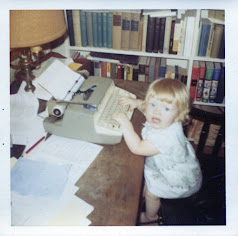
Christmas 1969 - Feeding my grandfather mince pie.


Friday, February 20, 2015

Friday's Faces From the Past - Ada Merritt Hobbs Matthews

First, a shout out to the cousin who found me through my blog earlier this week.  I got your email but it had no return address and I could not reply.  Please email me again or check your facebook, I sent a message there, too.

This week's installment of my grandfather's autobiography included the death of his mother when she was 64 and he was 18.  He was the youngest of her six children, born 22 years after her first child, Lillian.


The three photos above were the only I had ever seen of her until recently (the woman on the right is her sister Elizabeth Hobbs Snell).  My grandfather had written that he had a photograph of her as a child in London but I did not remember ever seeing it and had no idea if it still existed.  Then in December, with my birthday card, my stepmother sent me some photos she found while cleaning out a desk.  Among them were these:


Well, you'll just have to imagine my excitement, but I can tell you I was practically shouting out loud.  I couldn't believe I was finally holding not only the photo I had been hoping still existed somewhere but another of her as a young woman.

I am so amazed and grateful to have all these images of my great-grandmother.  While I am fortunate to have at least one image of each of my great-grandparents I don't have anything like this range in ages for most of them, this is such a gift.

Tuesday, February 17, 2015

Tombstone Tuesday - Ada Merritt Hobbs Matthews

Yesterday's installment of my grandfather's autobiography included the death of his mother, Ada Merritt Hobbs Matthews.

She died in Carbondale, Pennsylvania in 1919 and was buried with her husband Arthur William Matthews at the Pittston Cemetery.


ADA HOBBS MATTHEWS
WIFE OF ARTHUR W MATTHEWS
SEPTEMBER 1, 1919
AGE 64


As I related shortly after my visit, I was able to find their plot with the help of Ron Faraday, President of the Greater Pittston Historical Society.

Monday, February 16, 2015

Amanuensis Monday - An Ouside Job, Losing Mother and Higher Education?

Pittston Methodist Church, Pittston, PA - 2013
This is the 11th installment of the autobiography of my paternal grandfather, Howard B Matthews.  This part starts from the time he decided a job with the mine company but outside the mine itself would be safer.  At 18, already without a father, he loses his mother as well and has to start living with siblings.  Then he decides that there may be a better life for him if he can find a way to get back to school, but not just any school.

Because World War I was in process, it was easy to find jobs.  So I became shipper at the Exeter mine of the L.V. Coal Co. located just south of West Pittston. As the 3-ton cars of coal came up from the mine, they were hoisted to the top of a 5-story building called a Breaker.  There the contents were dumped into revolving crushers which reduced the larger mined pieces to the various smaller sizes which were needed in the commercial markets. Then the coal went through large tanks of water which removed, by a flotation process, the chucks of rock or slate. Finally, the now almost pure coal was run across a series of punched hole plates which sorted the coal into various sizes, - egg, chestnut, pea, buckwheat, etc. Each size was then loaded into 40 or 60 ton railroad hopper cars, for shipment via railroad to customers.

As Shipper, I sat in a glass enclosed office at a desk in front of which, within my reach, was the arm of a balance scale (similar to the small one on bathroom scales, with a sliding weight to move the balance). Outside, 6 feet below, was the scale platform crossed by railroad tracks which ran from above the Breaker to the RR classification yard beyond the scale. The loaded railroad cars moved by gravity and it was my job to read the name and number of the car (like C&O 13400) and its empty weight (printed on the car) and then weigh it as it passed slowly over the platform scale. Sometimes I missed, if the car happened to be going too fast, and this enraged the railroad conductor because he then had to have that car snaked out of those already in the yard and rerun over the scale.

During pauses in the line of cars coming from the Breaker, I phoned the sales office of the LV Coal Co in Wilkes-Barre and told them what I had already, -- so many cars of Pea, so many Chestnut, etc. soon they would phone back to give me instructions as to whom and where each car was to be shipped. Then to guarantee correct information I had to spell back to them the names and destinations, numerically. For example, Joe Jones, Port Jervis, NY would be J the 10th (letter of the alphabet), O the 15th, E the 5th and so forth.  With practice this became easy and I could spout it back to them fast. Following this I would record the complete information in the log book, with a carbon to Wilkes-Barre, and prepare a Way-Bill for each car and hand them to the RR Conductor.

I don't remember exactly how long I held that job but when the position of Supply Clerk became vacated by an older man who left for war, I was offered the promotion and accepted it. Thus I became the youngest Supply Clerk in the whole Lehigh Valley Coal Co. This involved ordering, receiving and disbursing all kinds of materials needed by the miners and other workers and it included dynamite, blasting powder, and percussion caps.

Meanwhile, my brother-in-law Will Ahlers and my brother Charles left the Lehigh Valley Coal Co to accept similar positions with the Racket Brook Coal Co in Carbondale at the northern end of the anthracite region. Soon thereafter my mother passed away and I was left alone at age 18 and wen to live with brother Fred and later my sister Lillian's family, both in West Pittston. Then I too was offered and accepted a position at Racket Brook and moved to Carbondale to live with the Ahlers. Following the annual coal miners' strike (John L. Lewis called a strike every Labor Day) during which I was told I could either go on leave without pay or become a night watchman with pay, I accepted the latter, was handed a 45 revolver and was told to do night guard duty, 7 pm to 7 am. But I soon tired of this, resigned and took a position as a cost accountant with The Cross Engineering Co in Carbondale.

During this time, I continued to be active in the Methodist Church, especially among the young people in the Epworth League and had frequent contact with the pastor's family, especially his son, Charles Olmstead, who was then a Sophomore at Wyoming Seminary, a preparatory school in Kingston, Pa. founded in 1844. This opened my eyes to the desirability and possibility of more formal education although my  total assets at that time were $90 invested in Southern Pacific stock and a cut-down Ford with no windshield or mudguards.  Nevertheless, I went down to Wyoming in the summer of 1922 and was interviewed by President Levi Sprague. When I disclosed my assets Dr. Sprague said that the $90 would not be sufficient for the tuition, room and board bills and that all jobs available to students had already been spoken for for the coming year.

What happens next?  Come back next week to find out more.

Friday, February 13, 2015

Friday's Faces From the Past - Martha Ann Louden Linton

Martha Ann Louden Linton was the sister of my 3rd Great Grandmother, Elizabeth Louden Nimmo.  I shared her photo here two weeks ago when I didn't even know her name.


She was identified by one of her direct descendants who stumbled on my blog shortly after another cousin put us in touch with one another.  Tuesday I discovered that this same image is in the collection of the McCord Museum in Montreal.  They have acquired over 600,000 photographs taken by the Notman Studio.  You can see them here.


Even though the relatives I have found in this archive are distant cousins, I still feel as if I have stumbled on treasure with all the Quebec and Montreal history and did I mention the dresses??  Like Gone with the Wind. Gorgeous!

Monday, February 9, 2015

Amanuensis Monday - Life in the Mines


This is the 10th installment of my grandfather, Howard B Matthews', story.  In the last installment, his father, Arthur William Matthews, passed away at the age of 71, when my grandfather was only 14.  The following year, after the family moved out of Pittston, it was decided that my grandfather should leave school and contribute to the income of the family so that his brother Charles could be married.


After his father's death, my grandfather's family had to sell everything and move out of Pittston. 

The mechanic to whom I was assigned was named Jerry, an Englishman.  His shop, equipped with benches and tools, was located in a whitewashed and well lighted area near the foot of the shaft.  It was his job to maintain and sometimes replace the steam operated pumps which controlled the level of constantly dripping water in the mine, and various other machinery throughout the mine.  He took me on his rounds of many areas and levels of the mine, packing valves, tightening pipe joints, replacing clutch facings, etc., warning me to watch out for bare overhead wires, teaching me not to panic if my light blew out.  When later he trusted me to make a miles long trip alone, getting there, making a minor repair, getting back, -- a walk of several miles without meeting a soul, it was for me a major victory.  But Jerry could be tough; he chewed tobacco, began and ended every sentence with a curse and vowed that he would kill me if I ever missed the cutting tool that he was holding and I was supposed to hit with a sledge hammer. I never missed.  It took me years to get over thinking sentences without cuss words in them.

Soon it became apparent that what the Super really hired me for was to be the keeper of the Yardage Books.  In these were kept a record of the length and thickness of the rock a miner had to blast down and load in order to get the number of loaded cars he and his helpers produced and he was paid additionally for the aforesaid hindering rock.  He was an independent contractor and could hire as many helpers as he wished.  The payment for rock made up for any slowing down in his coal production.

In every two-week pay period I had to accompany the Assistant Superintendent, Malachi Glennon, on a tour of the entire mine, right up to the “face” of each of the scores of chambers (tunnels) where the actual  mining, the blasting and loading of coal was going on.  As we came to each area we were met by its foreman who accompanied us over his “workings”.  His primary responsibility was to push for loaded cars to meet the daily goals set by the Super but he of course knew of the problems encountered by his miners and he guided us in the allowances I entered in the yardage book.

These journeys were very interesting and I was either too young or too dumb to recognize the dangers although they did expose me to many of the dangers associated with underground mining.  Certainly, as I recognized later, I was safer just being with Malachi Glennon, a wonderful man then in his 50’s, huge but not fat, red-faced, redolent of last night’s liquor, but a kindly family man, father of a young man who was a stationary engineer at the head of one of the slopes I have described.

Malachi and I together were involved in two of the kind accidents typical of mining,  - a gas explosion and a fall-of-rock, otherwise known as a roof cave in.

Mines are ventilated by a forced air system which brings fresh air from outside, through the long tunnels and then by a series of doors and temporary movable ducts, called brattice-work, right up to where the miners are working at the face of the chambers.  The force of a sudden release of a pocket of gas, ignited either by blasting powder or any source of sparks or flame, reverses the flow of air, blasts open the control doors and scatters particles of coal and rocks. It was the air reversal and flying specks hitting us in the face that told Malachi what was happening. He immediately threw me to the ground and covered me with his own body.  We lay there while the burning gas, rolling along about 2 feet below the ceiling, burned itself out without harm to us.  Had there been enough gas to fill the entire tunnel we would have been burned to a crisp.

Again in the roof cave-in, because of his many years of experience, Malachi understood the implications of the sounds he heard, - the cracking of roof rock and the groaning of support timbers.  He pushed me ahead and we ran as tons of rock and timbers crashed behind.

It was some time after these events that Malachi asked me what I intended to do with my life and what were my ambitions.  I replied that I would like a job like his.  Malachi stared at me a while and then said: “Howard, get the hell out of here before you get kilt”. Probably after saving me twice he didn’t want to stretch our luck. Because of his concern and the knowledge that my working underground was worrying my mother sick, I decided to give it up despite the fact that inside jobs paid much better than outside jobs.  Besides, it was hurting my social life for, scrub as I did every day, it was difficult to get that coal dust out of my pores.  When I perspired it oozed out of my pores.  I remember one Sunday when I walked Miss Celeste Bonti home after Epworth League and her mother met us at the door and said, “Howard Matthews, don’t let me catch you kissing my daughter”.  (Actually, I had a find social life, unhindered by my job.)  I have wondered since why the family permitted me, at age 16, to go into the mines in the first place.  Around Pittston it might have been considered a natural thing to do, but we were living in Forty Fort, a rather affluent suburb.

In the next installment, my grandfather sees what can come from a good education and is determined not only to go back to school, but a very good school.

Transcription of above article: Mrs. Arthur Matthews and family, including Mr. & Mrs. William Ahlers, who have lived for many years on Nafus Street, have moved to Forty Fort, which will be more convenient for Mr. Ahlers, who is Chief Clerk for the Lackawanna division of the Lehigh Valley Coal Co. at the Wilkesbarre [sic] office, and also for Chas. Matthews, who is employed as colliery clerk at the Maltby colliery, of the Lehigh Valley.  The Matthews property, on Nafus street, consisting of the homestead and a single dwelling on the rear of the lot, has been sold to the Gaughan family, of Port Griffith, who have already moved to their new home.


Friday, February 6, 2015

Friday's Faces From the Past - Ministers

Last week I posted an uncaptioned photo of a woman from an album that we believe originally belonged to my 3rd great grandmother, Elizabeth Louden Nimmo.

This week I am posting the photos of two ministers that were also uncaptioned.  There were photos of three other ministers in her album but they were all captioned.  They include the minister who married her daughter Elizabeth, my 2nd great grandmother, and a Father Chiniquy who's very unusual story can actually be found on Wikipedia.

Here are the unidentified photos:


Spring Cleaning - Bookmarks

I made it! My desktop PC was getting slower and slower last week, but my new laptop shipped earlier than expected and arrived on Friday and ...